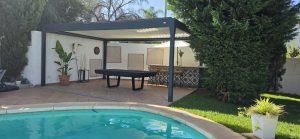
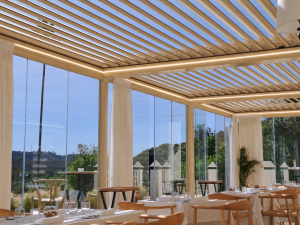
When people think about installing a pergola in a villa on the Costa del Sol, the first image is usually very clear: a shaded area beside the swimming pool, a dining table in the garden or a comfortable lounge area protected from the sun.
That is often the starting point. But in many villas, a pergola can do much more.
A well-designed pergola can connect different outdoor areas, improve the daily use of the property, protect key circulation zones, organise the architecture of the façade and create a more comfortable transition between the interior and exterior of the home.
This is especially important in villas in Marbella, Estepona, Mijas, Benalmádena, Sotogrande and other areas of the Costa del Sol, where outdoor living is not just occasional. It is part of the lifestyle, part of the value of the property and, in many cases, part of what buyers, guests or tenants expect from a Mediterranean home.
Before requesting a quotation, it is worth looking beyond the obvious question: “Where do we want shade?”
The better question is:
Where can a pergola make the villa more comfortable, more functional and more coherent as a whole?
A pergola is not only a roof: it is part of the villa’s outdoor architecture
In a villa, the outdoor space is rarely a single area. There may be a garden, a pool terrace, a porch, a barbecue area, a parking space, a side passage, an entrance patio, a guest apartment, a chill-out area or a transition between the living room and the exterior.
A pergola can help define these spaces.
It can create a dining area where there was only an empty terrace. It can make a poolside lounge usable during the hottest hours of the day. It can protect the entrance to the house from sun and rain. It can cover a parking area without visually closing the façade. It can also give continuity between different volumes of the property.
This is why, in villa projects, the pergola should not be treated as an isolated product. It should be considered as part of the overall design of the home.
For owners, this means more comfort and more daily use of the exterior. For architects, builders, interior designers and landscape designers, it means integrating shade, structure, materials and proportions from the beginning of the project.
If you are still comparing different systems, our guide on bioclimatic pergolas, enclosures and aluminium louvres can help you understand the role of each solution.
The pool area: the most obvious place, but not always the only one
The swimming pool is often the first area where clients imagine a pergola.
This makes sense. Pool areas are highly exposed to sun, glare and heat, especially in south-facing or west-facing villas. A pergola can create a shaded lounge, a dining area, a relaxation zone or a more comfortable space for family and guests.
However, the pool area requires careful planning.
The pergola should not block important views. It should not interfere with circulation around the pool. It should not create an uncomfortable obstacle between the house and the garden. It should also be positioned according to the path of the sun, not only according to the layout of the floor plan.
In many cases, a pergola near the pool works best when it is connected to the living room, kitchen or outdoor dining area. This creates a more natural flow between the interior and exterior of the villa.
For villas where the pool area is the main outdoor feature, we also recommend reading how to design the perfect outdoor space around your pool and garden on the Costa del Sol.
The terrace: an extension of the living room
In many Costa del Sol villas, the main terrace is the real heart of the property.
It may be connected to the living room, kitchen, dining area or master bedroom. It is where people have breakfast, receive guests, enjoy the view or spend long evenings outdoors.
A pergola in this area can completely change the way the villa is used.
With the right structure, the terrace becomes less dependent on the season and the hour of the day. A bioclimatic pergola with adjustable aluminium louvres can help regulate shade, ventilation and light. A fixed panelled pergola can provide a more stable covered area. A retractable or fabric solution may work in certain settings where flexibility is the main priority.
The key is not to choose the most expensive system automatically, but to choose the solution that fits the real use of the space.
Will the terrace be used mainly for lunch?
Will it be used in the evening?
Does it receive strong afternoon sun?
Is there exposure to wind?
Will the client later want glass curtains, vertical screens or lighting?
Does the pergola need to integrate with existing architecture?
These questions are essential before defining the model, measurements and technical configuration.
Entrances and access areas: often forgotten, but very important
One of the most underestimated uses of a pergola in a villa is the entrance area.
In many homes, the entrance is not just a decorative point. It is where people arrive every day, park the car, unload shopping, receive visitors, wait under the sun or move between the gate, driveway and front door.
A pergola can make this area more comfortable and more elegant.
It can protect part of the access route, create a more defined arrival experience and improve the visual relationship between the driveway and the house. In villas with large façades, a pergola can also help soften the scale of the architecture and give structure to an otherwise open or undefined area.
This is particularly relevant for premium villas, holiday homes and properties prepared for sale or rental, where first impressions matter.
For real estate professionals and property developers, a well-planned entrance pergola can add perceived value without necessarily changing the internal layout of the home.
Parking areas: protection without turning the villa into a garage
Many villas have outdoor parking areas rather than closed garages.
In these cases, a pergola can protect vehicles from direct sun, reduce heat inside the car and improve the appearance of the parking area. It can also provide a more discreet and architectural alternative to a conventional carport.
However, parking pergolas need to be studied carefully.
The structure must allow comfortable access for vehicles. The height, post position, drainage and turning radius must be considered. It is also important to decide whether the pergola should be visually connected to the house or designed as an independent element.
In some villas, the parking pergola can be integrated with the entrance route. In others, it may be better to separate the parking structure from the main outdoor living areas.
This is where custom aluminium structures can be especially useful. You can read more in our article on custom aluminium pergolas for Costa del Sol villas.
Porches, side areas and secondary terraces
Not every useful outdoor area is next to the pool.
Some villas have side terraces, covered porches, patios, service areas or secondary spaces that are underused simply because they are too exposed to sun, wind or rain.
A pergola can bring these areas back into daily use.
A side terrace can become a quiet breakfast area. A rear patio can become a protected laundry or storage transition. A porch can become a more comfortable outdoor dining area. A small secondary terrace can become a shaded reading corner or guest area.
This is important because a villa’s value is not only in its main spaces, but in how well the whole property works.
For interior designers and landscape designers, these secondary areas are often opportunities to improve comfort without major building work.
Bioclimatic, panelled or fixed pergola: which option makes sense for a villa?
There is no single pergola model that is perfect for every villa.
A bioclimatic pergola is often a strong option when the client wants control over light, ventilation and shade. The adjustable aluminium louvres allow the space to adapt throughout the day. This can be very useful in terraces, pool areas and outdoor dining zones.
A panelled pergola may be more suitable when the priority is a fixed covered area, a simpler solution or a more continuous roof effect. This can work well in access areas, parking zones, porches or spaces where constant shade is more important than adjustability.
A retractable or fabric-based solution may be interesting in certain cases, especially where the client wants a lighter visual effect or flexible coverage.
The right decision depends on the orientation, wind exposure, architectural style, expected use and budget.
If the client is still comparing systems, we recommend reading bioclimatic pergola vs other pergolas before making a decision.
Orientation, wind and drainage: key technical points in Costa del Sol villas
On the Costa del Sol, sun exposure is only one part of the equation.
Wind, sea air, orientation, drainage and fixing points also matter.
A pergola installed in a protected garden is not the same as one installed on an exposed hillside villa, a beachfront property or an elevated terrace. The structure, anchors, dimensions and accessories should be adapted to the real conditions of the site.
This is particularly important in coastal areas, where wind and salinity can affect materials, mechanisms and fixings over time. Aluminium structures, quality finishes and correct installation are essential for long-term performance.
Drainage should also be planned from the beginning. Many pergolas include integrated water evacuation through the structure, but this does not mean they should receive uncontrolled water from other roofs, terraces or façades.
For properties exposed to wind or coastal conditions, our article on common pergola mistakes in windy and coastal areas is especially relevant.
A villa pergola should be planned before comparing prices
One of the most common mistakes is requesting several quotations before defining the real scope of the project.
Two pergola quotes may look similar at first sight, but they can include very different structures, profiles, motors, drainage systems, lighting, fixings, installation conditions and accessories.
In villa projects, this difference can be even greater.
A pergola for a simple garden terrace is not the same as a pergola that must integrate with a façade, protect a parking area, connect several outdoor zones or allow future glass curtains or vertical screens.
Before comparing prices, it is better to define:
The exact location of the pergola.
The intended use of the space.
The orientation and exposure to sun and wind.
Whether the pergola will be attached to the house or freestanding.
The approximate dimensions.
The desired height.
The need for lighting, screens or glass enclosures.
The access conditions for installation.
The architectural style of the villa.
This makes the quotation process more realistic and avoids comparing solutions that are not equivalent.
For this reason, we recommend reading what you should know before requesting a pergola quote on the Costa del Sol and how to compare pergola quotes in Costa del Sol.
CTA — Planning a pergola for your villa?
At Pérgolas Sunset, we design, supply and install aluminium pergolas for villas, terraces, gardens, pool areas, entrances and outdoor living spaces on the Costa del Sol.
Before recommending a model, we study the location, measurements, orientation, use, access and technical conditions of the property.
You can send us photos, approximate measurements and a brief description of the area you want to improve. We will help you assess which type of pergola makes sense for your villa.
For architects, builders, developers and real estate professionals
In villa projects, a pergola is not only a product requested at the end of the process.
It can be part of the architectural design, the landscape concept, the outdoor living strategy and the commercial value of the property.
When considered early, the pergola can be better integrated with:
façade lines,
floor levels,
drainage points,
lighting,
outdoor furniture,
landscaping,
pool areas,
parking zones,
privacy requirements,
and future enclosures.
This is why architects, builders, interior designers, landscape designers, promoters and real estate professionals should treat pergolas as part of the project, not as a last-minute accessory.
A well-integrated pergola can make a villa feel more complete, more usable and more coherent.
Final thoughts: the best pergola is the one that improves how the villa is lived
Installing a pergola in a villa is not only about adding shade.
It is about understanding how the property is used every day.
Where do people arrive?
Where do they eat?
Where do they rest?
Where is the sun too strong?
Where does the wind affect comfort?
Which outdoor areas are currently underused?
Which spaces could become more valuable with the right structure?
A pergola can transform a pool area, but it can also improve entrances, terraces, porches, parking spaces and secondary outdoor zones.
In a Costa del Sol villa, where outdoor living is central to the lifestyle and value of the property, this wider vision is essential.
The goal is not simply to install a pergola.
The goal is to create a more comfortable, functional and elegant outdoor environment.
Final CTA
If you are planning a pergola for a villa in Marbella, Estepona, Mijas, Málaga, Benalmádena, Sotogrande or another area of the Costa del Sol, contact Pérgolas Sunset.
We will help you study the space, compare suitable options and choose a solution adapted to your property, your lifestyle and the technical conditions of the project.
FAQs
Is a pergola only suitable for the pool area of a villa?
No. Although pool areas are common locations, a pergola can also improve terraces, porches, entrances, parking areas, side patios and outdoor dining spaces.
What type of pergola is best for a villa on the Costa del Sol?
It depends on the location, orientation, wind exposure and intended use. Bioclimatic pergolas are ideal when light and ventilation control are important. Fixed or panelled pergolas may be suitable for parking, entrances or areas where constant coverage is preferred.
Can a pergola be attached to the façade of a villa?
Yes, in many cases a pergola can be attached to the façade, reducing the number of posts and creating a more integrated appearance. However, the wall condition, height, fixing points and drainage must be assessed first.
Can a pergola help protect a car in an outdoor parking area?
Yes. A pergola can provide shade and partial weather protection for vehicles while improving the visual appearance of an outdoor parking area. The structure must be designed with enough height, access and manoeuvring space.
Should architects or builders plan the pergola before construction finishes?
Ideally, yes. Early planning helps integrate structure, drainage, lighting, levels and future enclosures. This usually leads to a cleaner and more coherent result.
Can glass curtains or vertical screens be added later?
In many projects, yes, but it is better to consider this possibility from the beginning. The pergola structure, dimensions and fixing points should be prepared for future accessories when possible.
Is a pergola completely waterproof?
A pergola can provide a high level of rain protection depending on the model and installation, but it should not be presented as a fully sealed extension of the house. Wind-driven rain, drainage conditions and connection points must always be considered.
What information is needed to request a pergola quote for a villa?
Photos, approximate measurements, location, type of space, orientation, desired use, height limitations and whether the pergola should be attached or freestanding are very useful for preparing a realistic proposal.