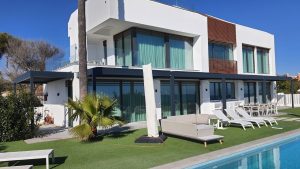
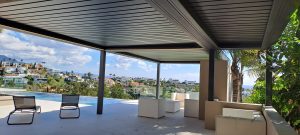
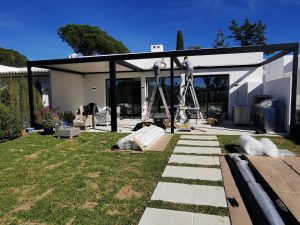
When planning a pergola, the way the roof operates can have a significant impact on everyday use.
Some pergola systems available on the market use a manual crank or handle, while others use an electric motor operated through a remote control or compatible control system.
At first glance, the difference may appear simple: one requires manual operation and the other uses a motor. In practice, however, the size of the pergola, the type of roof, how frequently it will be adjusted and the level of control expected from the outdoor space can all influence which operating system makes sense.
There is also an important distinction that is sometimes overlooked:
Motorisation is not the same as automation.
A pergola can be motorised without incorporating weather sensors or automatic routines. Sensors and automation are additional possibilities that depend on the pergola model, controls and selected configuration.
In this guide, we explain the difference between manual and motorised pergolas, what each system involves and why motorised operation has become particularly relevant in contemporary outdoor projects.
What is a manual pergola?
A manual pergola uses physical operation rather than an electric motor to move its adjustable or opening roof.
Depending on the system, this may involve a crank or another mechanical control used to adjust the roof.
The principal characteristic is straightforward: the user provides the force required to operate the mechanism.
Manual operation can still be found in some pergola systems on the market, particularly where the dimensions and roof configuration allow it.
However, whether manual operation is appropriate should not be determined solely by the desire to avoid a motor.
The size of the roof, frequency of use and characteristics of the mechanism all matter.
What should be considered with manual operation?
A manual system means:
- The roof must be physically operated by the user.
- Adjustment requires direct intervention each time conditions change.
- No electrical supply is required specifically for roof motorisation.
- Weather sensors cannot independently operate a roof that has no compatible motorised control.
- Ease of operation can vary according to the dimensions and characteristics of the system.
For a relatively small system that is adjusted infrequently, manual operation may be available from some manufacturers.
As dimensions increase or the roof is expected to be adjusted frequently, however, the experience of operating it manually can become an increasingly important consideration.
What is a motorised pergola?
A motorised pergola uses an electric motor to operate the movable elements of the roof through a controlled mechanical system.
Depending on the pergola, this movement may control the rotation of aluminium louvres in a bioclimatic pergola or the opening and closing of a retractable roof system.
At Pérgolas Sunset, both our bioclimatic pergolas and all our retractable pergola systems require motorised mechanical operation.
This is not simply a matter of convenience.
Motorised operation allows the mechanism to move in a controlled and consistent way, applying force more uniformly throughout the operating cycle. This helps avoid the irregular or excessive manual force that could otherwise be applied to moving components and mechanisms.
For this reason, appropriate motorised operation also contributes to correct system performance and to preserving its service life when the pergola is used as intended.
The user additionally benefits from easier operation, particularly when the roof is adjusted regularly as sunlight, shade or weather conditions change.
Manual operation vs motorisation: the main differences
| Aspect | Manual operation | Motorised operation |
|---|---|---|
| Roof movement | Physical operation by the user | Electric motor |
| User effort | Required | Minimal |
| Frequent adjustments | Requires repeated manual operation | Controlled from the compatible control |
| Larger movable roofs | Depends on system limitations | Particularly relevant for larger or frequently operated systems |
| Electrical supply for roof operation | Not required | Required |
| Weather sensors | No automatic motor response | May be possible depending on model and configuration |
| Automation | Not applicable to roof movement | May be possible with compatible equipment |
| Current Pérgolas Sunset range | Not currently offered | Yes |
This table should not be interpreted as saying that every motorised pergola automatically includes sensors, smartphone control or home automation.
Those are separate features.
Motorisation is not the same as automation
This distinction is particularly important when comparing pergola quotations.
A motorised pergola simply means that a motor operates the relevant movable part of the pergola.
Automation means that compatible controls or devices can trigger actions according to programmed instructions or external conditions.
For example, depending on the model and configuration, a pergola may potentially incorporate compatible:
- Wind sensors.
- Rain sensors.
- Control systems.
- Remote controls.
- Other automation functions supported by the selected equipment.
Their availability should always be confirmed for the specific pergola model.
Therefore, seeing the word motorised in a quotation does not necessarily mean that sensors or automatic weather responses are included.
This is one of the details worth checking when comparing pergola quotes.
Considering a motorised pergola for your property?
At Pérgolas Sunset, we assess the pergola system, dimensions, installation conditions and intended use before recommending a configuration. Our current bioclimatic and retractable pergola systems are motorised.
You can contact our team with the approximate dimensions, location and photographs of your outdoor space for an initial assessment.
Why does pergola size matter?
The dimensions of a pergola influence the configuration of its movable elements, but at Pérgolas Sunset motorisation is not reserved only for large pergolas.
Our bioclimatic and retractable systems use motorised mechanical operation regardless of whether the project is relatively compact or covers a larger outdoor area.
As dimensions and movable elements increase, controlled operation becomes particularly relevant. However, the underlying principle remains the same: the mechanism should operate through the system designed for it rather than relying on irregular manual force.
A motorised system applies movement in a controlled and consistent manner, helping the mechanism operate correctly throughout its intended travel.
The exact dimensions, number of modules and configuration still depend on the selected pergola model and the characteristics of each project.
Frequency of use can matter as much as size
A pergola may be adjusted several times during a single day.
Morning sun may require one position, midday another, and the evening may allow the roof to open further.
This is particularly relevant with a bioclimatic pergola, where the orientation of the louvres can be changed according to the desired balance between sunlight, shade and natural ventilation.
With a retractable fabric or PVC pergola, the owner may similarly want to extend or retract the roof as conditions change.
If these adjustments form part of normal everyday use, convenient operation becomes more valuable.
Motorisation makes these changes easier to incorporate into the way the terrace is actually used.
What does motorisation change in a bioclimatic pergola?
A bioclimatic pergola uses adjustable aluminium louvres to regulate sunlight, shade and natural ventilation.
Motorisation allows the user to change the position of those louvres through the pergola’s control system rather than manually operating the roof.
This is particularly useful because the value of a bioclimatic pergola lies partly in its ability to adapt.
If you want a broader explanation of how this roof system works, see our guide to what a bioclimatic pergola is.
It is also important not to confuse motorised louvres with a retractable roof.
In a conventional bioclimatic pergola, the louvres rotate but remain above the terrace.
Other pergola systems can use a retractable roof that gathers towards one side.
Our comparison of bioclimatic, fixed panelled and retractable pergolas explains these differences in more detail.
What about motorised retractable pergolas?
Motorisation is not exclusive to bioclimatic pergolas.
Retractable fabric or PVC pergolas can also use motors to extend and retract their roof.
In these systems, motorisation facilitates the transition between a covered terrace and a more open outdoor area.
This can be especially useful when the roof is adjusted regularly according to sunlight, season or the way the terrace is being used.
The important distinction remains the same:
motorisation describes how the roof moves; it does not define the type of pergola.
A bioclimatic pergola and a retractable pergola can both be motorised while using completely different roof systems.
Does a motorised pergola require electricity?
Yes. A motorised roof requires an appropriate electrical supply.
This should be considered when planning the project, particularly when the pergola is being integrated into a terrace, garden or existing property.
The exact electrical requirements depend on the selected system and equipment.
If lighting, compatible sensors or additional motorised accessories are also being considered, these requirements should be identified as part of the overall project rather than treated as an afterthought.
For new-build or renovation projects, considering the pergola during the design stage can make this coordination easier. Our article on integrating a pergola from the design phase explores this broader approach.
Are sensors necessary?
No.
A motorised pergola does not necessarily need weather sensors.
Whether sensors are useful depends on the pergola model, configuration, location and intended use.
Compatible sensors may be available for certain systems, but they should be treated as additional control elements rather than an inherent characteristic of motorisation.
This distinction is also important commercially.
When comparing proposals, check exactly what is included:
- Motorisation.
- Controls.
- Lighting.
- Sensors, if applicable.
- Installation.
- Other equipment or accessories.
Two quotations describing a “motorised pergola” may therefore include different equipment.
Does motorisation make a pergola maintenance-free?
No.
Motorisation does not eliminate the need for appropriate care and maintenance.
A pergola remains an outdoor structure exposed to sunlight, dust, rain, wind and environmental conditions.
The structure, drainage areas, movable elements and installed equipment should be kept in suitable condition according to the characteristics and recommendations of the selected system.
Likewise, it would be misleading to assume that a manual pergola is automatically more reliable simply because it has no motor.
The overall performance of a pergola depends on the quality of the system, correct use, installation, exposure and maintenance—not only on whether the roof is manual or motorised.
What about wind and changing weather?
Motorisation can make it easier to operate a pergola when weather conditions change, but a motor does not make the pergola immune to wind or adverse weather.
Exposure remains an important project consideration, particularly on penthouses, coastal properties and open terraces.
Similarly, adding a wind or rain sensor should not be interpreted as replacing appropriate use or the technical requirements of the pergola.
If the property is particularly exposed, see our guide to common pergola mistakes in windy and coastal areas.
Is a manual pergola cheaper?
A manually operated system may avoid the cost associated with motors and electrical controls, but the final price of a pergola cannot be determined from the operating system alone.
Price can also depend on:
- Dimensions.
- Type of pergola.
- Number of modules.
- Configuration.
- Finishes.
- Lighting and accessories.
- Lateral elements.
- Installation conditions.
- Access to the property.
- Other project-specific requirements.
For that reason, comparing a manual pergola from one manufacturer with a motorised pergola from another solely on price may not provide a meaningful comparison.
The complete specification matters.
Is a motorised pergola worth it?
That depends on what the project requires.
For a pergola that is used frequently, incorporates adjustable or retractable roof elements and forms an important part of the outdoor living space, convenient operation can have considerable practical value.
The question should therefore not simply be:
Is the motor worth paying for?
A better question is:
How often will the roof be operated, and what type of operation is appropriate for this pergola?
For the pergola systems currently offered by Pérgolas Sunset, motorised operation forms part of the product configuration.
What should you check when comparing motorised pergolas?
The word “motorised” by itself tells you very little about the complete proposal.
When comparing different quotations, it is useful to check whether they are actually offering comparable solutions.
Consider:
- Which pergola system is being proposed?
- What roof movement is motorised?
- What controls are included?
- Are sensors included, optional or unavailable?
- Is lighting included?
- What installation work is included?
- Are electrical works included or separate?
- What other accessories or lateral elements form part of the proposal?
- What after-sales support is provided?
This helps avoid comparing two prices that correspond to substantially different projects.
For a broader framework, read How to Compare Pergola Quotes.
Frequently asked questions
What is the difference between a manual and motorised pergola?
A manual pergola requires the user to physically operate its movable roof mechanism. A motorised pergola uses an electric motor to perform the relevant movement through a compatible control.
Are all bioclimatic pergolas motorised?
Not necessarily across the entire market. Different manufacturers may offer different configurations. The bioclimatic pergolas currently commercialised by Pérgolas Sunset are motorised.
Does a motorised pergola automatically include wind and rain sensors?
No. Motorisation and sensors are separate features. Compatible sensors may be available depending on the pergola model and selected configuration.
Is motorisation the same as home automation?
No. Motorisation means an electric motor operates the movable element. Automation involves additional compatible controls or programmed functions.
Can retractable pergolas be motorised?
Yes. Motorisation can operate retractable fabric or PVC roofs as well as orientable louvres, depending on the pergola system.
Is a manual pergola more reliable?
Not necessarily. Reliability cannot be determined solely by whether a pergola is manual or motorised. The system, installation, use, exposure and maintenance all matter.
Does a motorised pergola require more maintenance?
The motor and controls are components of the system and should be maintained according to the manufacturer’s requirements. It is not useful to assume that every motorised pergola necessarily requires more overall maintenance than every manual one.
Can a motorised pergola operate during a power cut?
Normal motor operation requires electricity. Any alternative or emergency operation depends on the specific system and should be verified for the selected model rather than assumed.
Are Pérgolas Sunset pergolas motorised?
Yes. Pérgolas Sunset’s bioclimatic pergolas and all its retractable pergola systems use motorised mechanical operation.
Conclusion: manual vs motorised is about how the pergola will actually be used
Manual and motorised operation represent two different ways of controlling the movable elements of a pergola.
Manual operation requires direct physical input from the user. Motorisation replaces that repeated manual action with controlled electric movement.
The importance of that difference increases according to the type of roof, dimensions, frequency of use and way the outdoor space is expected to function.
It is equally important to distinguish motorisation from automation. A motorised pergola does not automatically include weather sensors, smartphone control or programmed routines; these depend on the equipment and configuration selected.
At Pérgolas Sunset, our bioclimatic pergolas and all our retractable pergola systems use motorised mechanical operation. Beyond convenience, this provides controlled movement and a more uniform application of force, helping avoid unnecessary stress on the mechanism and supporting correct operation and service life.
Motorisation does not necessarily mean automation: compatible sensors and additional automated functions depend on the selected model and configuration.
If you are considering a pergola for a villa, penthouse, terrace, garden or commercial space, you can contact Pérgolas Sunset to discuss the characteristics of your project and the most appropriate pergola configuration.
Spanish version: Pérgola manual o motorizada: diferencias y cuál elegir