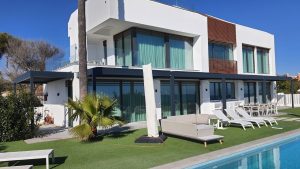
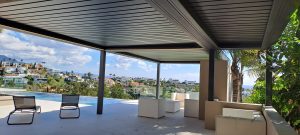
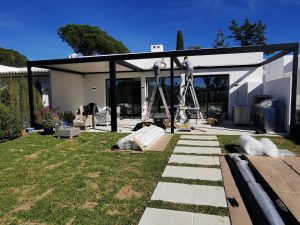
Choosing a pergola is not simply a question of deciding which system is the most advanced.
A homeowner may begin by asking for a bioclimatic pergola, only to discover that a retractable fabric roof provides the degree of opening they actually want. Another project may initially favour a lighter textile solution, while the intended use makes a fixed panelled or bioclimatic structure more appropriate.
This is why choosing a pergola should not begin with the assumption that one system is always better than another.
A bioclimatic pergola, a fixed panelled pergola and a retractable fabric or PVC pergola create different types of outdoor spaces. They differ in the way they manage sunlight, ventilation, rain, roof opening, maintenance, appearance and investment.
The right question is therefore not simply:
Is a bioclimatic pergola better?
A more useful question is:
Which type of pergola responds best to the way this particular outdoor space will be used?
In this guide, we compare the three principal pergola families offered by Pérgolas Sunset and explain when each one can make sense for a terrace, garden, villa, penthouse, porch, carport or commercial outdoor area.
If you are unfamiliar with adjustable-louvre systems, start with our guide explaining what a bioclimatic pergola is and how it works.
Quick comparison: bioclimatic, panelled or retractable?
| Type of pergola | Main strength | Main consideration | Particularly suitable for |
|---|---|---|---|
| Bioclimatic pergola | Adjustable sunlight, shade and natural ventilation | Greater control requires a more sophisticated roof system | Adaptable outdoor living areas |
| Fixed panelled pergola | Permanent protection and consistent shade | The roof cannot be opened or adjusted | Carports, entrances, porches and permanently covered spaces |
| Retractable fabric/PVC pergola | Extensive roof opening and flexible shade | Performance depends on the selected membrane and system | Terraces, gardens and hospitality areas requiring greater opening |
This comparison provides an initial orientation.
The final choice also depends on the intended use of the space, dimensions, orientation, exposure, architecture, access and budget.
Not sure which type of pergola fits your project? Explore our gallery of completed pergola installations or contact our team for an initial assessment.
What should a pergola do for your outdoor space?
Before comparing products, it is important to define the function of the area.
Two terraces with similar dimensions may require completely different pergolas.
One may need permanent protection for an outdoor dining table. Another may prioritise a roof that opens as much as possible. A third may need adjustable shade and natural ventilation because the terrace functions as an extension of the living room.
Before choosing a system, consider:
- How will the outdoor area be used?
- Is the priority shade, ventilation, rain protection or extensive roof opening?
- Will the space be used occasionally or throughout much of the year?
- Is it beside a living room, kitchen, pool or commercial dining area?
- How much natural light should remain near the façade?
- Is the property particularly exposed?
- Will lateral protection or privacy be required?
- Could the use of the space change in the future?
- What level of investment is appropriate for the intended use?
These questions help determine whether the project genuinely benefits from a bioclimatic system or whether a fixed panelled or retractable pergola may provide a more appropriate solution.
Bioclimatic pergola: adjustable control throughout the day
A bioclimatic pergola uses adjustable aluminium louvres to regulate sunlight, shade and natural ventilation.
The louvres can move to different positions according to the time of day, season and desired level of protection.
When closed, they can provide overhead protection during moderate rain while water is directed towards the pergola’s integrated drainage system.
In our bioclimatic systems, the aluminium louvres also incorporate an internal air chamber. This construction feature helps limit the direct transmission of heat through the aluminium when the roof is closed, although it should not be interpreted as complete thermal insulation.
The principal advantage of a bioclimatic pergola is control.
It can help to:
- Reduce direct solar exposure.
- Create adjustable shade.
- Promote natural ventilation through the roof.
- Maintain natural light when conditions allow.
- Provide overhead protection during moderate rain.
- Integrate drainage within the structure.
- Incorporate motorised operation and lighting.
- Integrate compatible sensors or automation depending on the selected model and configuration.
- Accommodate compatible lateral complements where the project allows.
This adaptability can be particularly valuable when a terrace functions as an extension of a living room, dining area or kitchen.
A fixed roof always provides essentially the same coverage. A retractable roof can expose a larger part of the area above. A bioclimatic roof instead provides intermediate control by changing the position of its louvres.
When does a bioclimatic pergola make sense?
It can be particularly suitable when:
- The terrace is used at different times of day.
- Sunlight and natural ventilation need to be regulated.
- The owner wants a permanent architectural structure.
- The area is intended to function as an outdoor living space.
- Frequent adjustment of the roof is useful.
- Compatible glass, ZIP screens or privacy elements may be considered.
- The investment corresponds with the expected use of the space.
The advantages of a bioclimatic pergola become especially relevant when conditions and requirements change throughout the day or across the seasons.
When might another system make more sense?
A bioclimatic pergola is not automatically necessary for every project.
Another system may deserve consideration when:
- Permanent shade is the main requirement.
- The project is primarily a carport or covered entrance.
- Extensive roof opening is the priority.
- The area will only be used occasionally.
- A simpler roof adequately responds to the intended use and budget.
The most sophisticated solution is not automatically the most appropriate one.
Its value depends on whether the owner will genuinely benefit from the flexibility it provides.
Fixed panelled pergola: permanent and practical coverage
A fixed panelled pergola uses a permanent roof supported by an aluminium structure.
Depending on the model and intended purpose, the roof may incorporate suitable fixed panels. Unlike a bioclimatic or retractable system, the roof remains permanently in position.
Its main advantage is therefore straightforward: consistent overhead coverage.
This makes panelled pergolas particularly relevant for:
- Carports.
- Entrances to a property.
- Covered walkways.
- Porches requiring permanent shade.
- Outdoor service areas.
- Terraces where continuous overhead protection is preferred.
- Commercial areas with a clearly defined permanent use.
Depending on the selected configuration, a fixed panelled pergola can provide permanent shade, integrated drainage and a robust architectural structure without incorporating an opening roof.
When does a panelled pergola make sense?
A fixed system can be particularly useful when there is little benefit in opening or adjusting the roof.
For example, a carport generally needs consistent protection rather than adjustable ventilation. Likewise, an entrance or permanently covered porch may benefit more from continuous coverage than from a movable roof.
The relationship with the building still matters.
A permanent roof can influence the amount of natural light reaching nearby doors and windows, which is why dimensions, position and overall configuration should be considered as part of the project.
A panelled pergola is therefore not an inferior version of a bioclimatic pergola.
It is a different solution for a different requirement.
Retractable fabric or PVC pergola: flexibility and extensive opening
A retractable fabric or PVC pergola combines an aluminium structure with a roof membrane that can be opened and closed.
When the roof retracts, the material gathers towards one end, allowing a substantial part of the area above the terrace to remain open.
When extended, it provides shade and a level of protection determined by the selected membrane and system.
Its principal advantage is therefore the extent to which the roof can open.
This can be particularly attractive on the Costa del Sol, where an owner may want substantial solar protection during part of the day but a much more open terrace during mild evenings.
Depending on the model and configuration, a retractable system may provide:
- Extensive roof opening.
- Flexible solar protection.
- Motorised operation.
- A lighter visual appearance.
- Integration with an aluminium structure.
- Compatible lighting or lateral screens.
- Suitability for residential and hospitality terraces.
Fabric and PVC do not always provide the same performance
Not every textile roof is intended to perform in the same way.
Some fabrics are primarily designed to provide solar protection. Other systems using suitable PVC membranes can provide greater protection from rain.
For this reason, a retractable pergola should not automatically be described as waterproof, nor should every textile system be assumed to provide the same level of protection.
The characteristics of the selected system and manufacturer should always be considered.
When does a retractable pergola make sense?
It may be particularly appropriate when:
- Extensive roof opening is a priority.
- The terrace should feel substantially open when conditions allow.
- Flexible shade is required.
- A lighter architectural appearance is preferred.
- The project involves a residential terrace, restaurant, hotel or hospitality area where adaptable coverage is useful.
- The selected system provides the level of protection required for the intended use.
The difference from a conventional bioclimatic pergola is fundamental.
A rotating-louvre bioclimatic system changes the position of the aluminium louvres, but the louvres remain above the terrace.
A retractable fabric or PVC roof can gather towards one side, leaving a greater proportion of the overhead area open.
Bioclimatic, panelled or retractable: which fits each use?
The intended use of the space is often more important than the product name.
| Intended use or priority | Pergola worth considering |
|---|---|
| Adjustable sunlight and natural ventilation | Bioclimatic pergola |
| Permanent overhead coverage | Fixed panelled pergola |
| Extensive roof opening | Retractable fabric/PVC pergola |
| Outdoor living area used frequently | Bioclimatic or retractable, depending on desired opening |
| Carport or protected entrance | Fixed panelled pergola |
| Flexible residential terrace | Bioclimatic or retractable pergola |
| Permanent covered porch | Fixed panelled pergola |
| Precise solar control throughout the day | Bioclimatic pergola |
| Terrace where maximum opening is important | Retractable fabric/PVC pergola |
| Future glass, ZIP screens or privacy elements | Compatible aluminium pergola planned with these requirements in mind |
| Restaurant or hotel terrace | Bioclimatic, panelled or retractable, depending on operational requirements |
This is an orientation rather than an automatic selection tool.
The characteristics of the property and the way the space will actually be used can change which system is appropriate.
Shade, ventilation or extensive opening?
One of the clearest ways to distinguish the three pergola families is to consider the experience expected beneath the roof.
If the priority is adjustable sunlight and ventilation
A bioclimatic pergola deserves particular consideration.
Its adjustable louvres can create shade while allowing different degrees of natural ventilation and light.
If the priority is permanent coverage
A fixed panelled pergola may provide a more direct solution.
If the roof does not need to open or adjust, there may be little reason to incorporate movement that will rarely be used.
If the priority is extensive roof opening
A retractable fabric or PVC pergola may be more appropriate.
Retracting the membrane can leave a substantially larger part of the terrace open to the sky.
Defining which of these experiences matters most makes the comparison considerably easier.
What about rain?
Rain protection should be considered carefully because the three systems manage water differently.
Bioclimatic pergola
When the louvres are closed, a bioclimatic pergola can provide overhead protection during moderate rain while water is directed towards its integrated drainage system.
It should not, however, be presented as a completely watertight interior space under every possible weather condition.
Fixed panelled pergola
A fixed roof provides continuous overhead coverage.
The final level of protection still depends on the complete system, configuration and conditions around the structure.
A note on panelled roofs: This comparison focuses on fixed panelled pergolas. However, some panelled roof systems may also incorporate opening or retractable configurations, depending on the manufacturer and model. The operating mechanism should always be checked before comparing specific products.
Retractable fabric or PVC pergola
Performance depends significantly on the selected membrane and system.
Some textile roofs primarily provide shade, while appropriate PVC systems can offer greater rain protection.
In all three cases, these are outdoor structures. Wind-driven rain may enter through open sides, and weather conditions can affect the level of protection experienced beneath the pergola.
For properties in exposed or coastal locations, see our guide to common pergola mistakes in windy and coastal areas.
What about glass, ZIP screens and aluminium louvres?
Glass enclosures, ZIP screens and aluminium louvres are not additional types of pergola.
They are complementary elements that can be incorporated into compatible projects to address requirements such as:
- Lateral protection.
- Privacy.
- Low-angle sunlight.
- Visual filtering.
- Greater seasonal usability.
Not every pergola needs them, and not every side of a pergola needs the same solution.
If lateral protection is important, it is useful to consider it when defining the initial project, even if some elements may be installed later.
Our guide to bioclimatic pergolas, glass enclosures, ZIP screens and aluminium louvres examines these options in greater detail.
Does location change which pergola you should choose?
Location can influence the requirements of a project, but it does not automatically determine the type of pergola.
On the Costa del Sol, strong sunlight, frequent outdoor use, coastal exposure and the desire to connect indoor and outdoor living areas can make adjustable or opening roofs particularly attractive.
A bioclimatic system can provide control over sunlight and ventilation. A retractable system may be attractive when extensive opening is important. A fixed panelled pergola may be appropriate where permanent coverage is the priority.
In Castilla y León, seasonal temperatures and weather conditions may change how an outdoor area is expected to function throughout the year.
The important point is not to select a pergola from the climate alone.
The decision should combine location, intended use, exposure and the type of experience expected from the covered area.
Villa, penthouse, garden or commercial terrace?
The same pergola system can perform a different role depending on where it is installed.
A villa may prioritise the relationship between the house, garden and swimming pool.
A penthouse may place greater emphasis on views, exposure and access.
A restaurant may need adaptable shade for different periods of service.
A carport may simply require permanent overhead protection.
This is why photographs of another project can provide inspiration but should not determine the choice on their own.
For properties where installation context is particularly important, our guide to villa and penthouse pergola projects on the Costa del Sol explains some of these differences.
Common mistakes when comparing pergolas
Assuming that bioclimatic always means better
A bioclimatic pergola provides valuable control, but that flexibility may be unnecessary when permanent coverage or extensive opening is the real priority.
Choosing from photographs alone
A pergola that works beautifully on one property may not respond to the use, orientation or architecture of another.
Treating every retractable roof as the same
Fabric and PVC systems can have different characteristics and intended uses. The specific roof system matters.
Looking only at the final price
Two quotations can represent different systems, dimensions, equipment, finishes, installation conditions and after-sales services.
Our guide on how to compare pergola quotes explains what should be reviewed before comparing proposals.
Thinking about future complements too late
If glass, ZIP screens or privacy louvres are likely to be required in the future, it is worth discussing this during the initial project.
Assuming every large space should have as few posts as possible
Large areas require an appropriate configuration for the selected pergola and property.
The objective should be a balanced project rather than simply eliminating supports.
For a more detailed discussion of this subject, see Pergola Without Posts? What to Consider for Large Open Spaces.
Frequently asked questions
Is a bioclimatic pergola better than other pergolas?
Not necessarily. A bioclimatic pergola provides adjustable control over sunlight and natural ventilation, but a fixed panelled or retractable pergola may respond better when permanent coverage or extensive roof opening is the priority.
What is the main difference between a bioclimatic and panelled pergola?
A bioclimatic pergola uses adjustable aluminium louvres. A fixed panelled pergola has a permanent roof that provides continuous coverage but cannot regulate light or ventilation by opening or rotating its roof.
What is the difference between a bioclimatic and retractable pergola?
A conventional bioclimatic pergola regulates the roof by changing the position of its aluminium louvres. A retractable fabric or PVC pergola gathers its membrane towards one side, allowing a larger part of the overhead area to open.
Which pergola is suitable for year-round use?
There is no universal answer. The intended use, local conditions, desired protection and possible lateral complements all influence the decision.
Which pergola is suitable for a carport?
A fixed panelled pergola can be a practical solution when permanent overhead protection is more important than adjustable ventilation or roof opening.
Which type of pergola costs less?
There is no fixed rule based only on the pergola family. Dimensions, configuration, equipment, finishes, installation conditions and accessories all influence the final price.
Can a retractable fabric or PVC pergola manage rain?
Some systems can provide rain protection, while others are primarily designed for shade. The characteristics of the selected membrane and roof system should be checked for the intended use.
Can glass enclosures or ZIP screens be added later?
In many projects they can, provided the selected pergola and configuration are compatible. If future enclosures are already being considered, discussing them during the initial project can help avoid unnecessary limitations later.
How do I know which pergola suits my property?
Start with the intended use rather than the product name.
Consider whether the priority is adjustable sunlight and ventilation, permanent coverage or extensive roof opening. Then consider the property, dimensions, exposure, architecture, access, complementary elements and available budget.
Conclusion: the best pergola is the one that fits the project
A bioclimatic pergola offers adjustable control over sunlight, shade and natural ventilation. It can be particularly useful for outdoor living areas used at different times of the day and year.
A fixed panelled pergola provides permanent overhead coverage. It can be especially appropriate for carports, entrances, porches and other areas where the roof does not need to open.
A retractable fabric or PVC pergola provides extensive opening and flexible shade, making it particularly interesting for terraces where the relationship between covered and open space changes according to the moment.
None of these systems is automatically better in every situation.
The appropriate choice depends on what the outdoor space needs to do, how frequently it will be used and how the pergola relates to the property and its surroundings.
At Pérgolas Sunset, we design and install bioclimatic pergolas, fixed panelled pergolas, retractable fabric/PVC pergolas and complementary solutions for villas, penthouses, gardens, terraces, porches, carports and commercial outdoor areas on the Costa del Sol, throughout Andalucía and in Castilla y León.
If you are comparing different pergola systems, you can contact our team, explore our pergola catalogue or visit our project gallery.