
On the Costa del Sol, outdoor living does not have to end when summer does. A well-planned pergola can help turn a terrace, garden, porch or penthouse into a space that can be enjoyed during many more months of the year.
But year-round pergola use depends on much more than the roof itself.
The position of the sun changes through the seasons. Wind can make an otherwise pleasant terrace uncomfortable. Evenings become cooler, daylight hours become shorter, and the way we use an outdoor space can change between summer and winter.
For this reason, creating a pergola for extended seasonal use means looking at the whole space: the roof system, orientation, exposure, lateral protection, lighting, privacy and, above all, how the area is intended to be used.
At Pérgolas Sunset, enquiries, photographs, site visits and real projects have repeatedly shown us the same thing: enjoying a pergola throughout the year starts by understanding the space, not simply by adding more features.
If you are still at the early stages of your project, our guide on what to know before requesting a pergola quote on the Costa del Sol can help you identify the information worth considering first.
Year-round pergola use starts with how you want to live outdoors
A pergola does not have to be simply a shaded area for the hottest months.
Depending on the property and project, it can become an outdoor dining area, a place to read or relax, an extension of the living room, a sheltered terrace for entertaining or a space connected to the garden or swimming pool.
The important question is therefore not only:
Which pergola should I choose?
It is also:
How would I like to use this outdoor space at different times of the year?
A terrace designed mainly to provide summer shade may have very different requirements from an outdoor dining area intended to be used on autumn evenings or sunny winter afternoons.
Understanding that distinction helps determine which features actually add value to the project.
Comfort depends on more than the pergola roof
The roof is naturally an important part of any pergola, but it does not determine the entire experience underneath it.
Sun can enter from the side. Wind can affect a dining or lounge area. Privacy may become important in neighbouring properties. During cooler months, allowing sunlight into the space may be preferable to blocking it.
Depending on the project, it may therefore be worth considering elements such as:
- sliding or folding glass;
- ZIP screens;
- aluminium louvred side panels;
- integrated lighting;
- heaters;
- sensors or automation, depending on the model and configuration.
This does not mean that every pergola needs every option.
Quite the opposite.
A well-planned outdoor space uses the elements that solve its actual needs rather than simply adding as many accessories as possible.
You can explore these possibilities further in our guide to bioclimatic pergolas, enclosures and aluminium louvres.
Summer: shade, ventilation and solar protection
Summer is usually when the purpose of a pergola seems most obvious: creating shade and making an outdoor area more comfortable.
However, even summer shade depends on orientation.
The midday sun does not enter a terrace in the same way as the lower sun later in the afternoon. A roof may provide effective overhead shade while sunlight continues to enter through one side.
Depending on the space, lateral protection such as a ZIP screen or aluminium louvres can therefore complement the roof.
With a bioclimatic pergola, adjustable aluminium louvres allow the amount of light entering the space to be regulated and can help manage ventilation. The louvres also incorporate an internal air chamber, a construction feature that helps limit direct heat transmission through the aluminium when the roof is closed.
But a bioclimatic pergola is not the only possible solution.
Depending on the intended use, architecture and requirements of the space, a project may also be better suited to a panelled pergola or a fabric/PVC system. Different systems may also offer retractable configurations depending on the model.
If you are still deciding between systems, our comparison of bioclimatic pergolas vs other pergola types explains the main differences.
Spring and autumn: lateral protection can make the difference
The transitional seasons illustrate particularly well why year-round outdoor living is not simply about the roof.
The temperature may be pleasant, but wind can make sitting outside uncomfortable. Low-angle sunlight may enter directly from one side, or occasional rain may affect an otherwise sheltered terrace.
This is where lateral protection can significantly change how the space is used.
Glass enclosures
Glass can provide protection from wind and lateral rain while maintaining natural light and views.
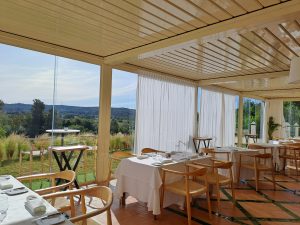
Depending on the project, sliding or folding glass systems can be particularly useful for terraces, porches, villas and penthouses where visual openness remains important.
ZIP screens
ZIP screens provide a more flexible form of lateral protection.
They can help control low-angle sunlight, improve privacy and provide protection in certain wind conditions, within the characteristics and limitations of the installed system.
Aluminium louvres
Fixed or adjustable aluminium louvres can help filter sunlight, increase privacy and visually separate different areas without necessarily creating a completely enclosed space.
The useful question is therefore not:
Which enclosure is best?
It is:
What do we need to control on this particular side of the pergola?
That might be sunlight, wind, privacy, views or a combination of several factors.
Winter on the Costa del Sol: using the outdoor space differently
Enjoying a pergola during winter does not necessarily mean trying to turn an outdoor terrace into an indoor room.
It means understanding when and how the space can continue to be useful as conditions change.
The Costa del Sol has many winter days when sunshine and relatively mild daytime conditions make outdoor living possible. On those days, protecting a terrace from wind while retaining sunlight can be more important than creating maximum shade.
This is why orientation and exposure matter.
A villa terrace sheltered by the building may behave very differently from an exposed penthouse only a few kilometres away.
Coastal exposure can introduce another set of considerations, including wind, humidity and proximity to the sea.
For projects in exposed locations, we explore these factors further in common mistakes when choosing a pergola in coastal and windy areas.
The wider lesson is simple:
“Year-round” does not mean exactly the same thing for every property.
Lighting extends the way a pergola can be used
Seasonal use is also connected to something much simpler: daylight.
During autumn and winter, evenings arrive earlier. In summer, meanwhile, terraces often become most enjoyable after sunset.
Lighting therefore has an important role in how long and how often the outdoor space is used.
Depending on the pergola model and configuration, integrated LED lighting can make the area suitable for dining, entertaining, reading or relaxing after dark.
Again, the objective is not simply to add another feature.
It is to think about what activities should remain possible once natural light disappears.
A villa and a penthouse do not have the same year-round requirements
The type of property can change the way a pergola is used throughout the seasons.
In a villa, the pergola may connect the house with a garden, swimming pool, outdoor dining area or summer kitchen. Protection and comfort may therefore need to work as part of a much larger outdoor environment.
We explore this in more detail in installing a pergola in a villa on the Costa del Sol.
A penthouse introduces different considerations. Height, exposure, wind, privacy, views, access and the characteristics of the building can all influence the project.
You can read more in our guide to pergolas for penthouses on the Costa del Sol.
We have also compared the two situations directly in villa vs penthouse pergola projects on the Costa del Sol.
The point is not that one type of property requires a particular pergola.
It is that the same idea of “year-round use” can translate into very different project priorities.
Think about how the pergola may evolve in the future
Not every project needs glass, ZIP screens or other lateral protection from day one.
But if you think you may want to add these elements later, it is useful to mention that intention while the project is being defined.
The same applies to lighting, privacy solutions and other features.
Whether something can be added later, and under what conditions, will depend on the pergola system, model and configuration. Thinking about future use does not mean that every option must be purchased immediately.
It simply means considering the outdoor space beyond its first summer.
Our guide to pergolas and enclosures provides a broader overview of the different possibilities.
Considering a pergola for year-round outdoor living?
If you are exploring how a pergola could work with your terrace, villa, penthouse or garden, you can browse our project gallery, review our pergola catalogues or contact our team to discuss your project.
What should you consider for year-round pergola use?
There is no universal list of accessories that turns every pergola into a year-round outdoor space.
Instead, it is useful to consider the relationship between:
- intended use;
- sun orientation;
- wind and exposure;
- local climate;
- lateral protection;
- privacy;
- lighting;
- possible future enclosures;
- the characteristics of the property itself.
The objective is not to create the most complicated pergola.
It is to create an outdoor space that remains useful in more situations and during more of the year.
Frequently asked questions about year-round pergola use
Can a pergola be used in winter?
Yes, depending on the climate, location and configuration of the project. Orientation, protection from wind and lateral enclosures can help extend the periods when the space is comfortable to use. However, an outdoor pergola should not automatically be considered equivalent to an indoor, climate-controlled room.
Does a pergola need to be fully enclosed for year-round use?
No. Some projects may benefit from glass, while others may only require protection on a particular side, a ZIP screen, aluminium louvres or no enclosure at all. The appropriate solution depends on the conditions affecting the space.
What is the best enclosure for a pergola?
There is no single best enclosure. Glass, ZIP screens and aluminium louvres respond differently to wind, sunlight, privacy, views and the desired degree of openness.
Is a bioclimatic pergola the best option for year-round use?
Not necessarily. Bioclimatic pergolas offer adjustable aluminium louvres, but panelled and fabric/PVC pergola systems can also be appropriate depending on the project. Retractable configurations may also be available across different systems depending on the model.
Can glass or ZIP screens be added later?
In some projects, yes. If future enclosures are being considered, it is useful to mention this when defining the initial project so that compatibility and possible constraints can be assessed for the chosen system and configuration.
Enjoying a pergola all year round means thinking beyond the roof
A pergola can help transform a terrace, garden, porch or penthouse into an outdoor space that becomes part of everyday life during more of the year.
But year-round use does not come from the roof alone.
Orientation, climate, exposure, lateral protection, lighting, privacy and intended use all contribute to how the space performs through different seasons.
That is why the starting point should not simply be:
“Which pergola do I want?”
It should also be:
“How do I want to use this outdoor space throughout the year?”
If you are considering a project on the Costa del Sol, you can contact Pérgolas Sunset and send us the location, approximate dimensions, photographs or plans of the space and how you intend to use it.


3 Comentario
[…] Intended use: A dining area by the pool needs different coverage than a chill‑out zone, outdoor kitchen or year‑round workspace. Define how you want to live outdoors—shade, rain protection, privacy, all‑season use—and let this guide the choice of roofing, lighting and lateral protection. To explore options for winter use, see how to enjoy your pergola throughout the year. […]
[…] te planteas cerrar la terraza en invierno, lee nuestro artículo ¿Cómo puedo disfrutar de mi pérgola todo el año?, donde explicamos opciones de cerramientos y […]
[…] to see how a pergola and glass enclosure can create a cosy winter garden? Explore our How Can I Enjoy My Pergola All Year Round? article for […]
¡Los comentarios están cerrados para este artículo!